For agencies, operations and distributed teams
Your whole team in one system —
not in six tools.
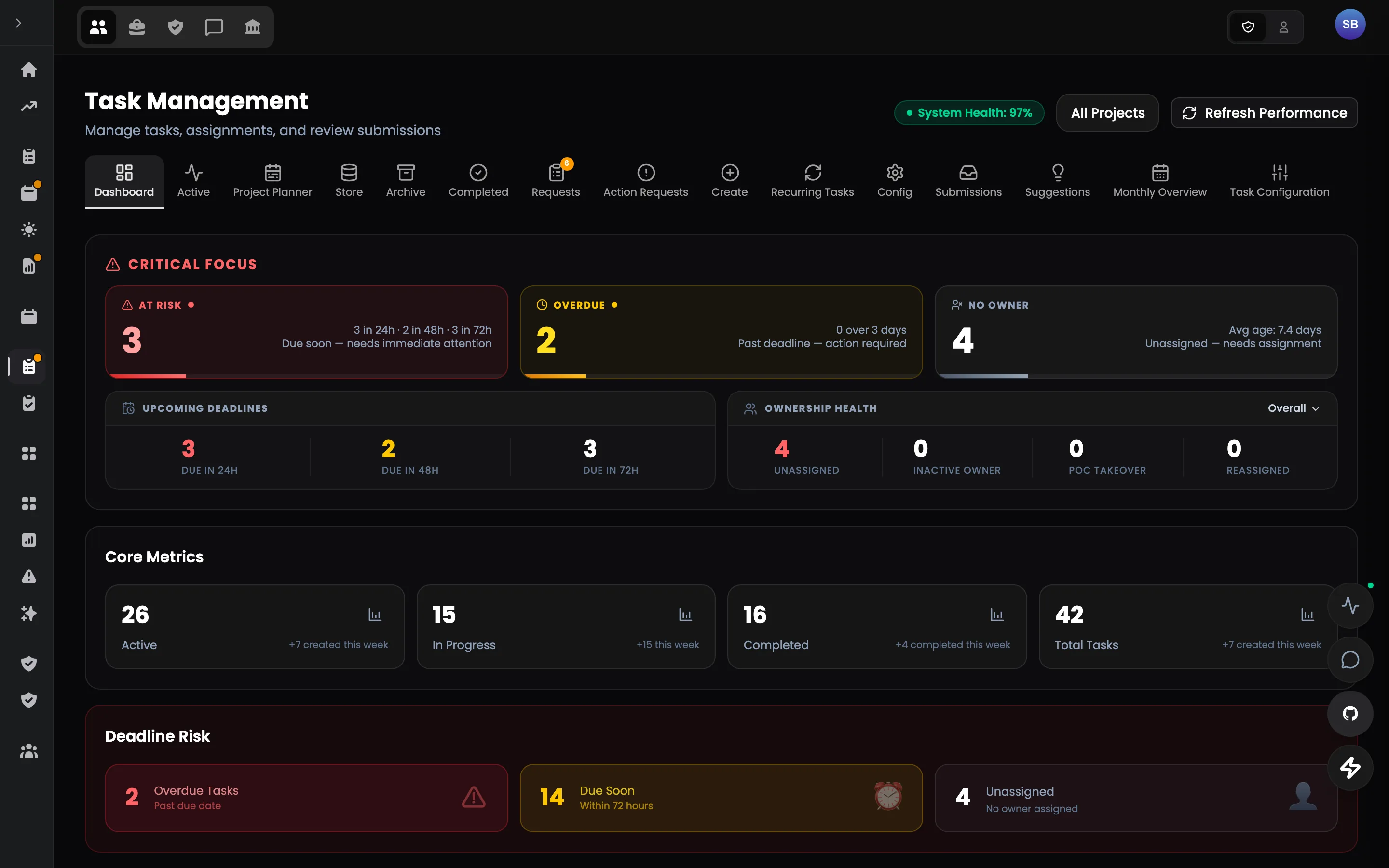
Hiring, tasks, shifts, check-ups, reports, pay and chat on one record. The weekly picture is computed from the work itself — nobody assembles it by hand on a Friday.
- Tools taken over
- 6
- System for everyone
- 1
- Entered twice
- 0
The problem
Six tools. Six versions of the truth.
Work in a task tool, people in a spreadsheet, attendance in a tracker, pay in another system, conversations in chat. Every handoff loses context — and someone assembles the picture by hand every Friday.
Spreadsheets
Rosters, leave and payments maintained by hand.
Chat threads
Briefs and decisions lost between messages.
Time trackers
Hours that never match what was reported.
Drives
Documents without owner, expiry or approval.
Inboxes
Applications screened from a résumé pile.
Manual chasing
Reminders instead of rules.
Who it is for
Built for organizations that run work through people.
Four shapes of organization where the same fragmentation shows up — each with its own pilot scope.
Agencies
Briefs, talents, reviews and delivery on one record.
For agencies and production teams that run creative or content work through a changing roster of people, with a brief, a deadline and a reviewer on every piece.
ExploreOperations teams
See today. Run today. Know what moved.
For operations leads running shifts, attendance, daily priorities and reports for a workforce — and assembling the picture by hand at the end of the week.
ExploreDistributed teams
One place to talk, with the work already in it.
For organizations whose people work across locations, time zones and shifts — where context is lost between the message, the task and the person.
ExploreGrowing companies
Add structure without adding another tool.
For companies whose stack has grown one tool at a time and whose managers now spend their week moving information between them.
Explore
Inside the product
Three pillars. One operational record.
Work, People and Operations are not separate products but three views of the same record — a change in one is known in the others. Pick a pillar, then a feature, and see where it lives.
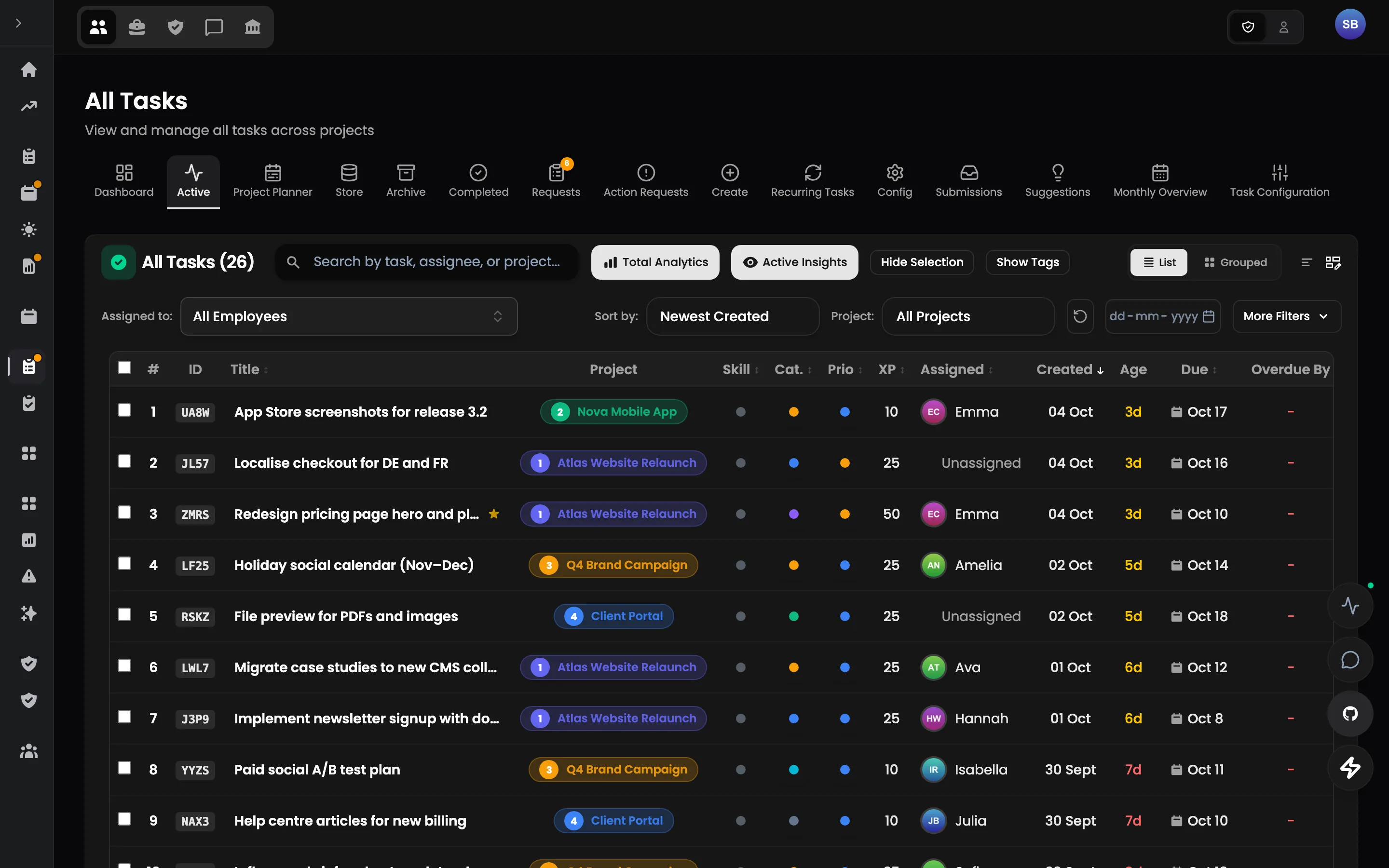
From request to reviewed, finished work.
Tasks are structured objects — title, project, requirements, assets, assignee, reviewer, deadline and XP — reviewed against what was asked instead of in a chat thread.
Explore Tasks & reviews →Signature features
Built around how the day actually runs.
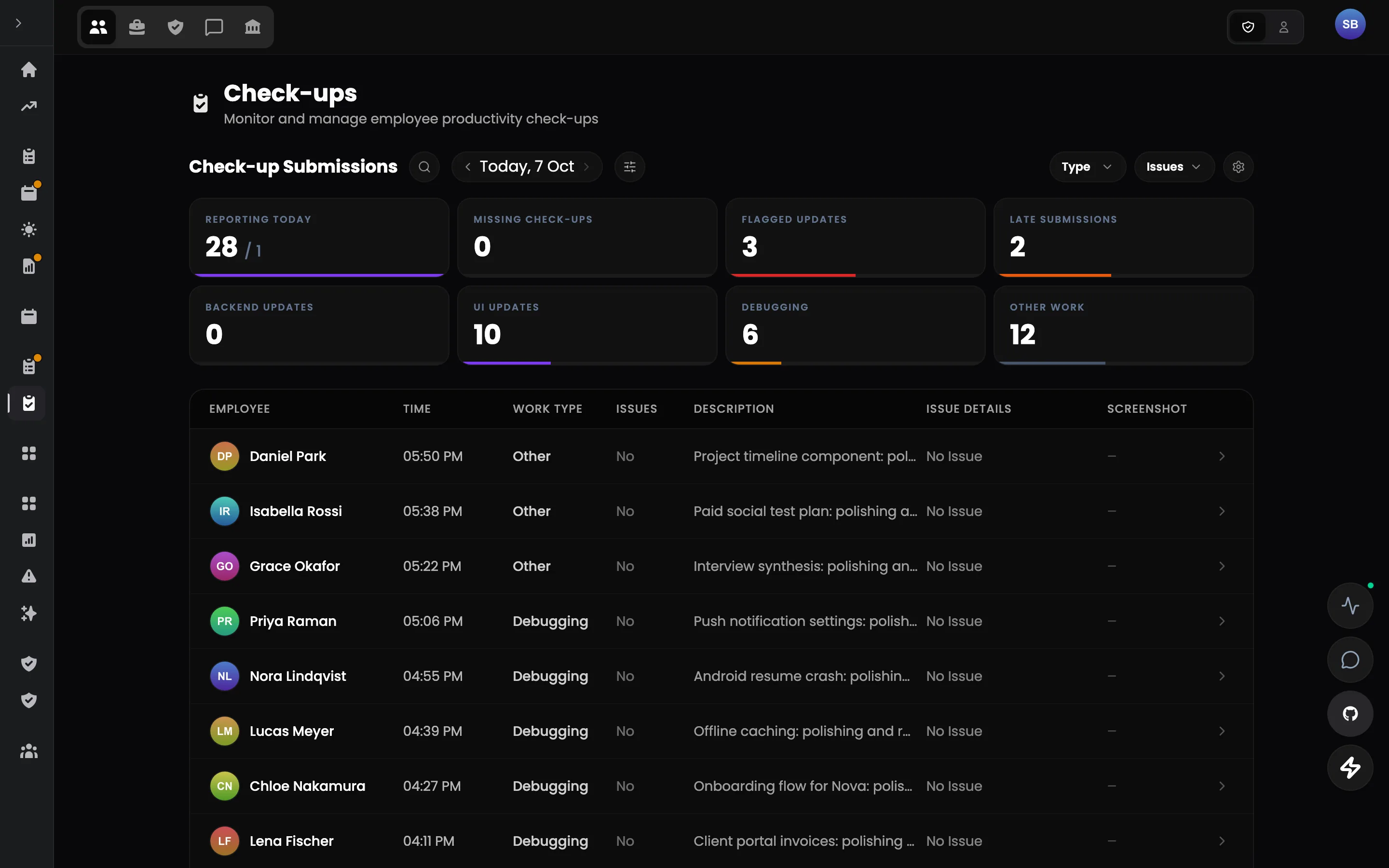
01 · Work
Daily check-ups
Morning intent. Evening proof.
Each person commits the day's deliverables in the morning and shows what moved in the evening — a daily loop that makes priorities visible per person, per day.
- Morning check-up — Deliverables and priorities committed at the start of the shift.
- Evening proof — The shift report — output, time breakdown, verification and work images — filed against the morning check-up.
- Three-hour check-ins — A short in-shift check-in — what is being worked on, any issue — pending, approved or flagged.
- Reviewed by a person — Three-hour check-ins are approved or flagged; shift reports can be sent back for revision.
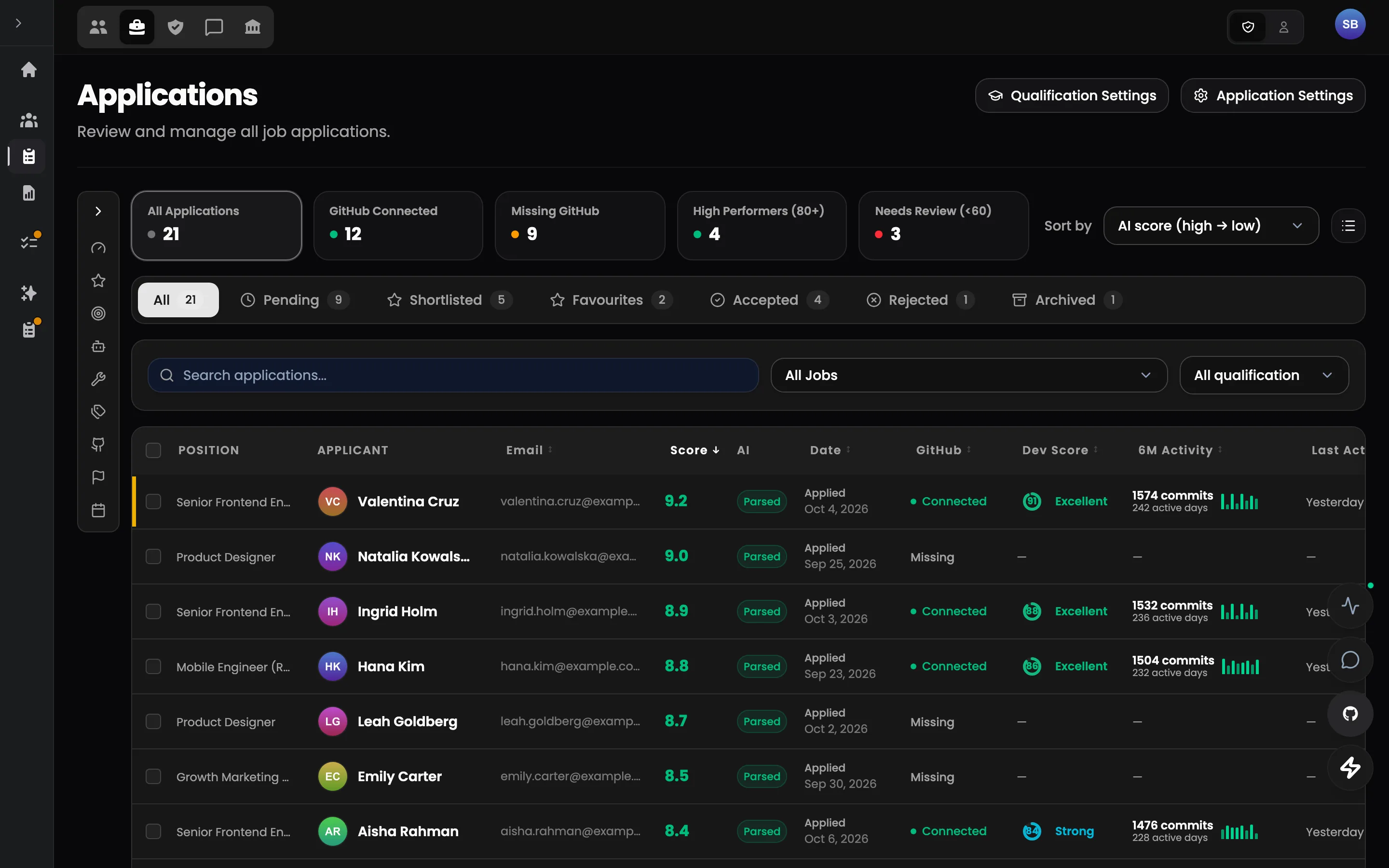
02 · People
Hiring pipeline
Hire on evidence, not on a résumé pile.
Every applicant with status, parsed skills, answers, notes and next step — pending, shortlisted, accepted or rejected, with onboarding started from the accepted application.
- Screening room — Applicants by status with notes and next step — filtered on evidence.
- Résumé parser — AI extracts skills and history from uploaded CVs into structured fields.
- GitHub intelligence — Repository activity and profiles as evidence in screening.
- Structured applications — Questions, uploads and qualifications instead of an inbox.
Dual perspective
One truth. Two purpose-built lenses.
Admins get the context to run the organization. Talents get the context to own their work. Both look at the same record.
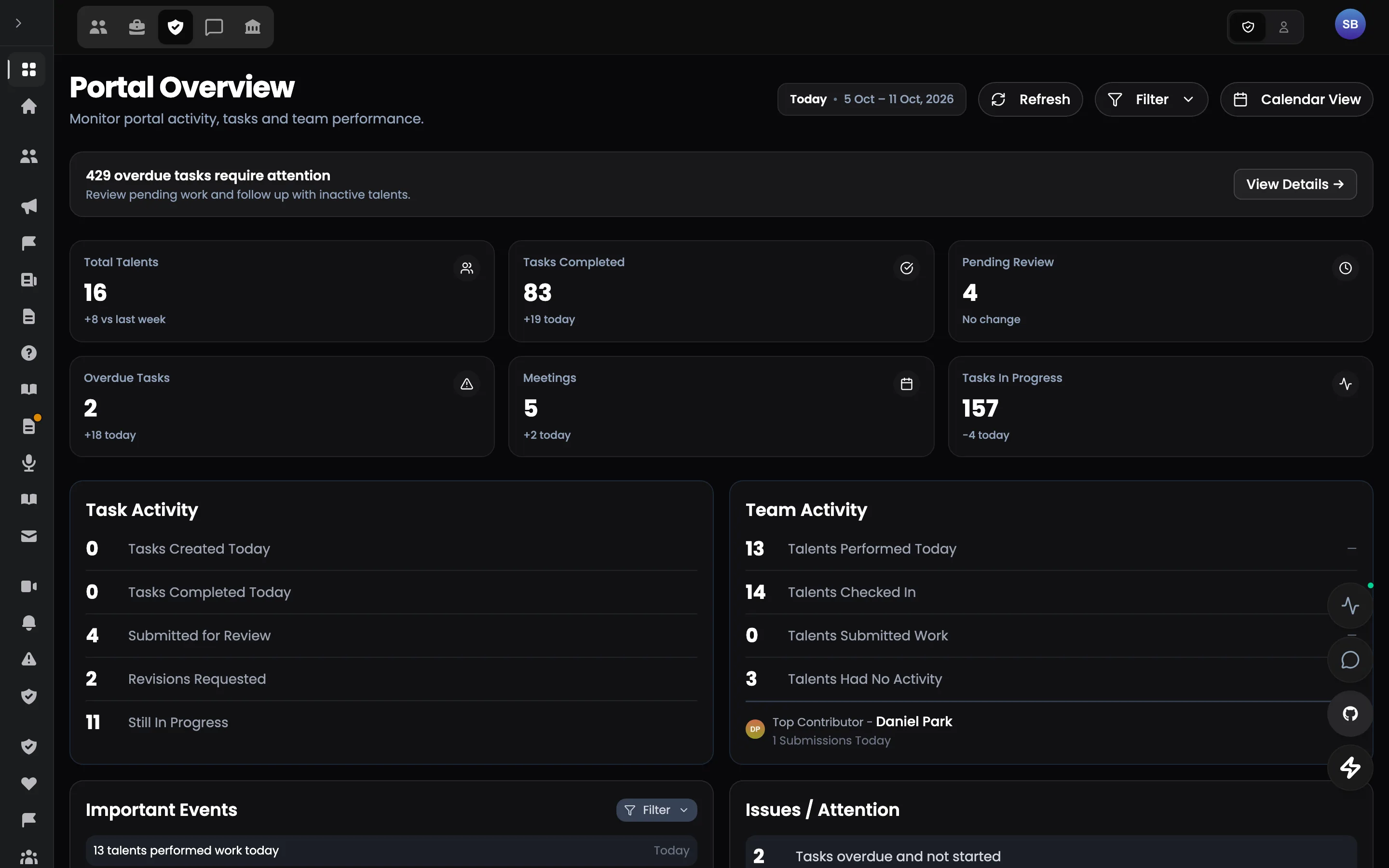
The admin lens
Health of the whole operation in one screen: check-ups, tasks, meetings, attendance and who needs attention today.
- Operational health at a glance
- Who needs support, visible early
- Every number opens its records
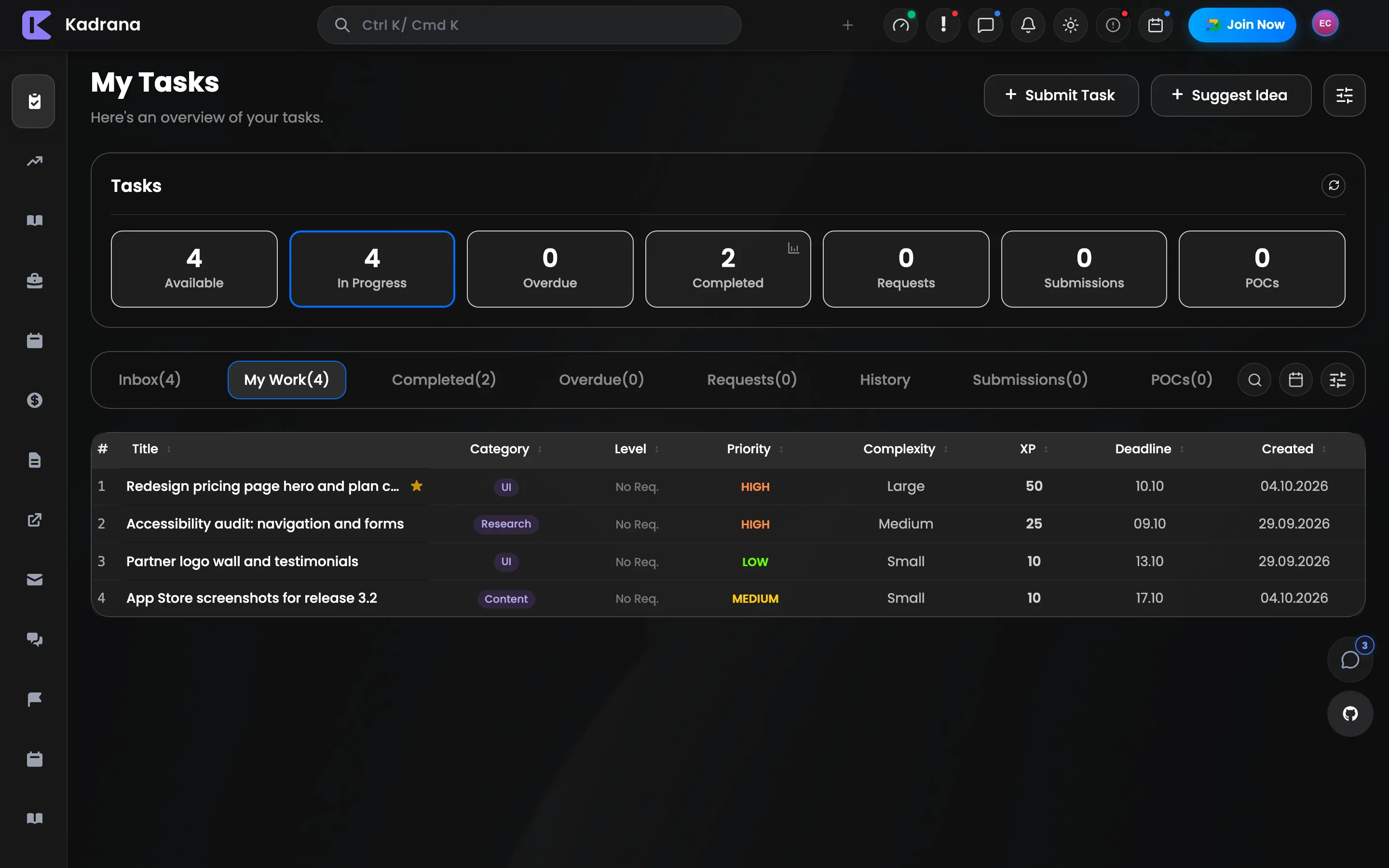
The talent lens
Everything a talent needs to own their work: tasks, schedule, time off, documents, payments, learning and their standing.
- Tasks with XP and clear review rules
- Schedule, time off and pay in one place
- Their own score, check-ups and reviews in view
Recognition built in
Make good work visible.
XP, badges and leaderboards.
Approved work and participation earn experience points; levels unlock access, badges mark milestones and leaderboards run monthly and all-time. Every award is configurable and recorded.
Explore XP, badges & leaderboard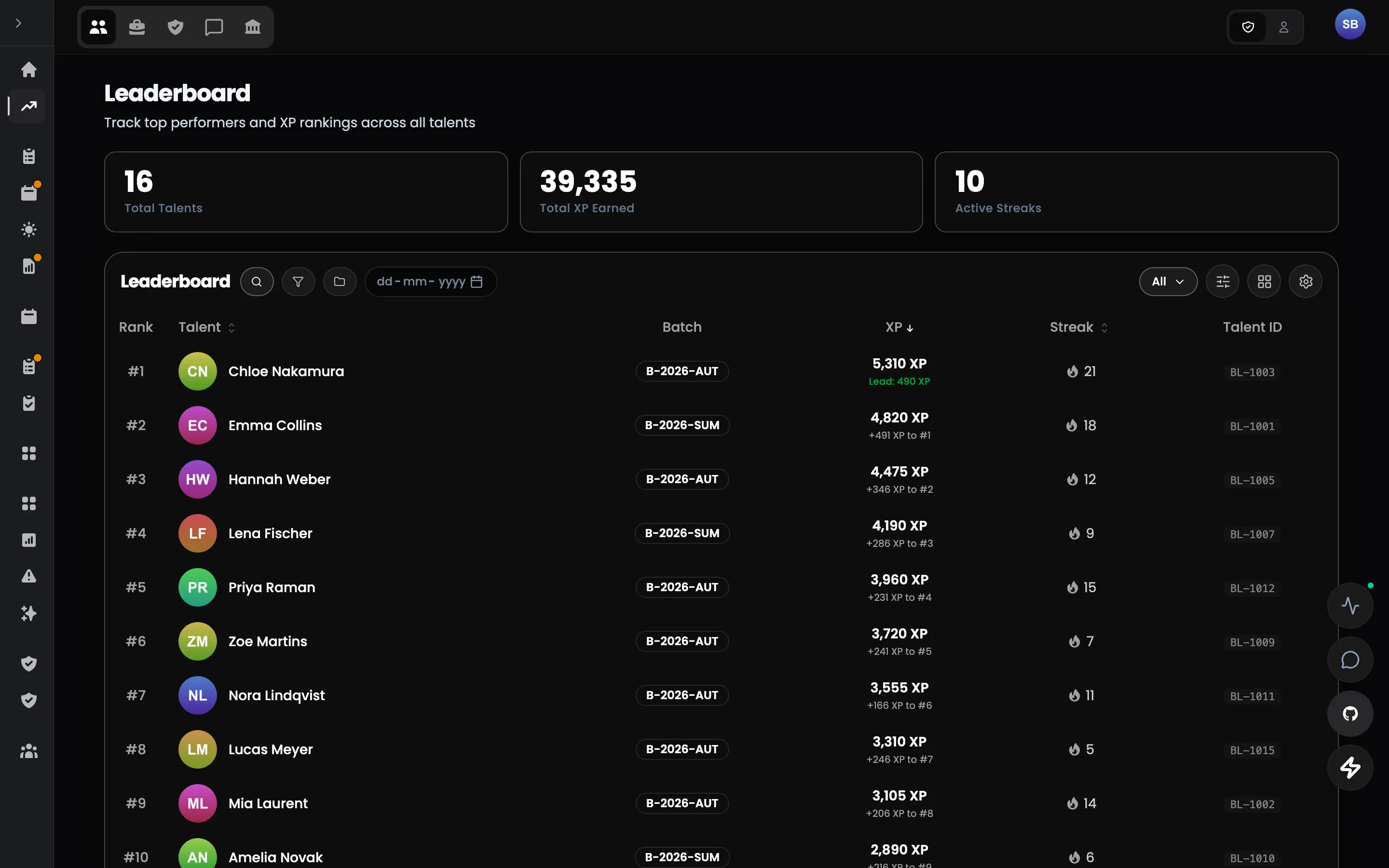
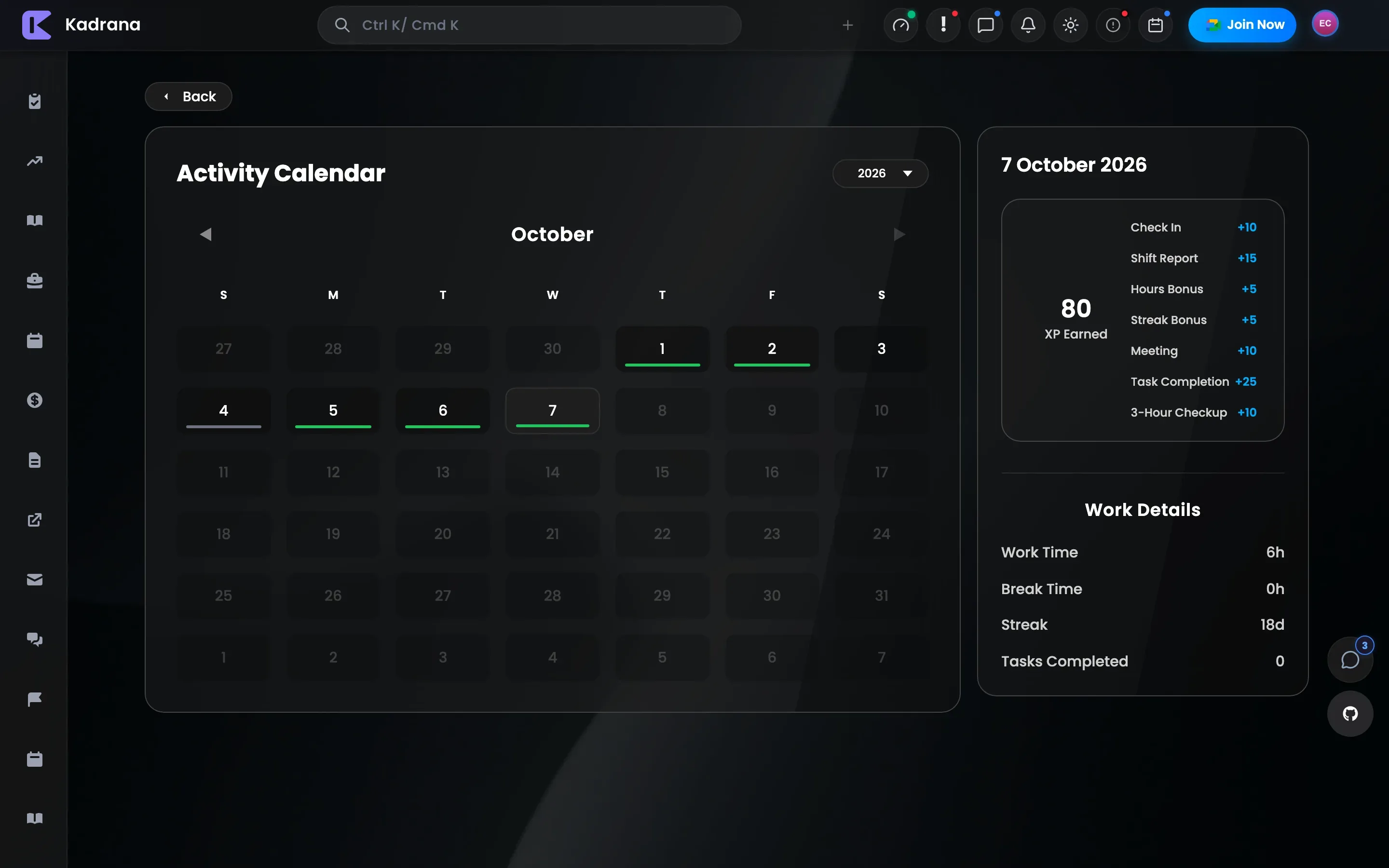
Portals
Six portals. Each one for a job.
Workspaces, Operations, Talent, Hiring, Communication and Admin — each a focused surface on the same data.
Work
Workspaces
Where the work itself gets done.
ExploreOperations
Operations
Run the day-to-day of the whole workforce.
ExplorePeople
Talent portal
The same record, from the talent's side.
ExplorePeople
Hiring
From public careers page to first day.
Explore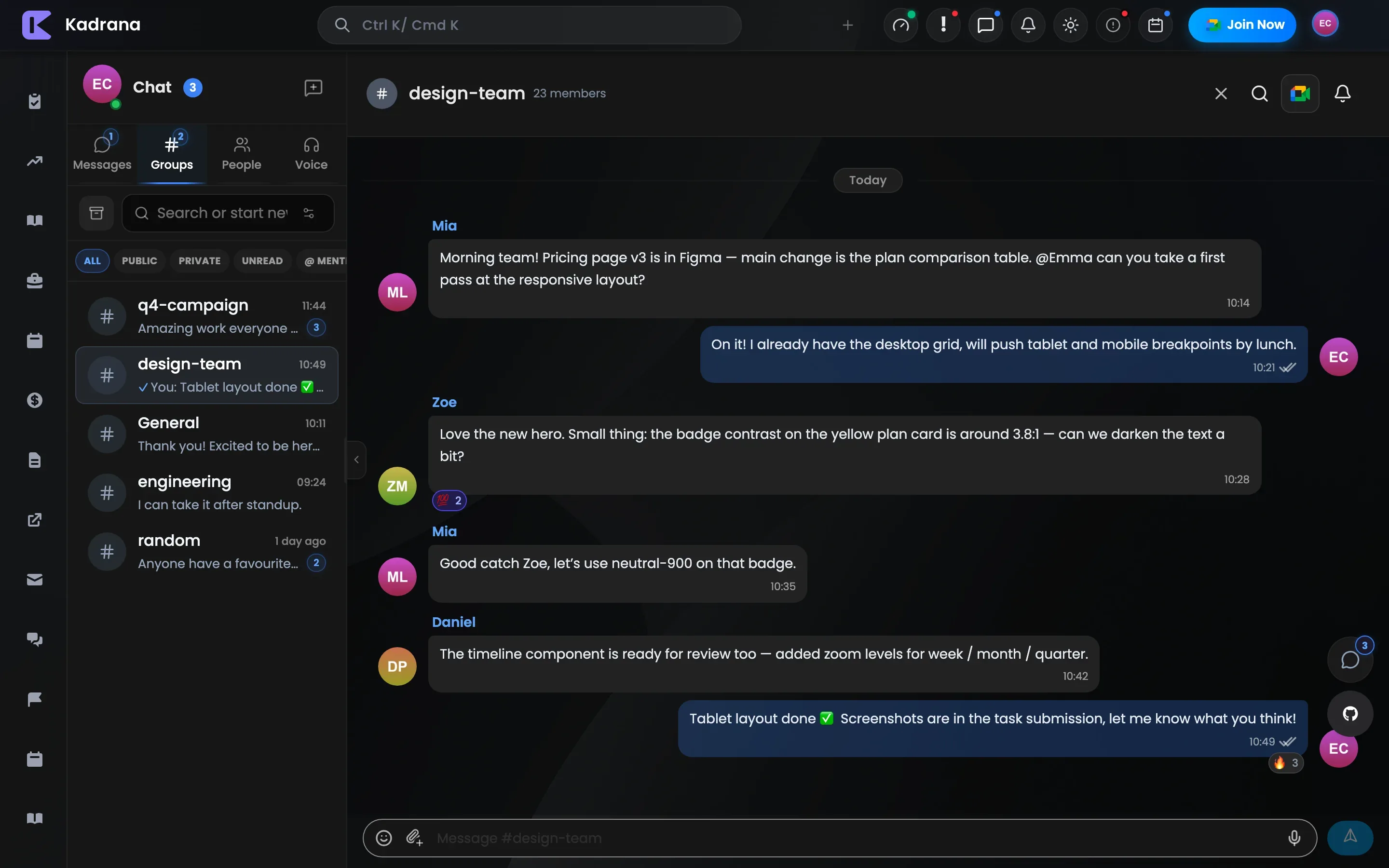
Operations
Communication
One messenger for the whole organization.
Explore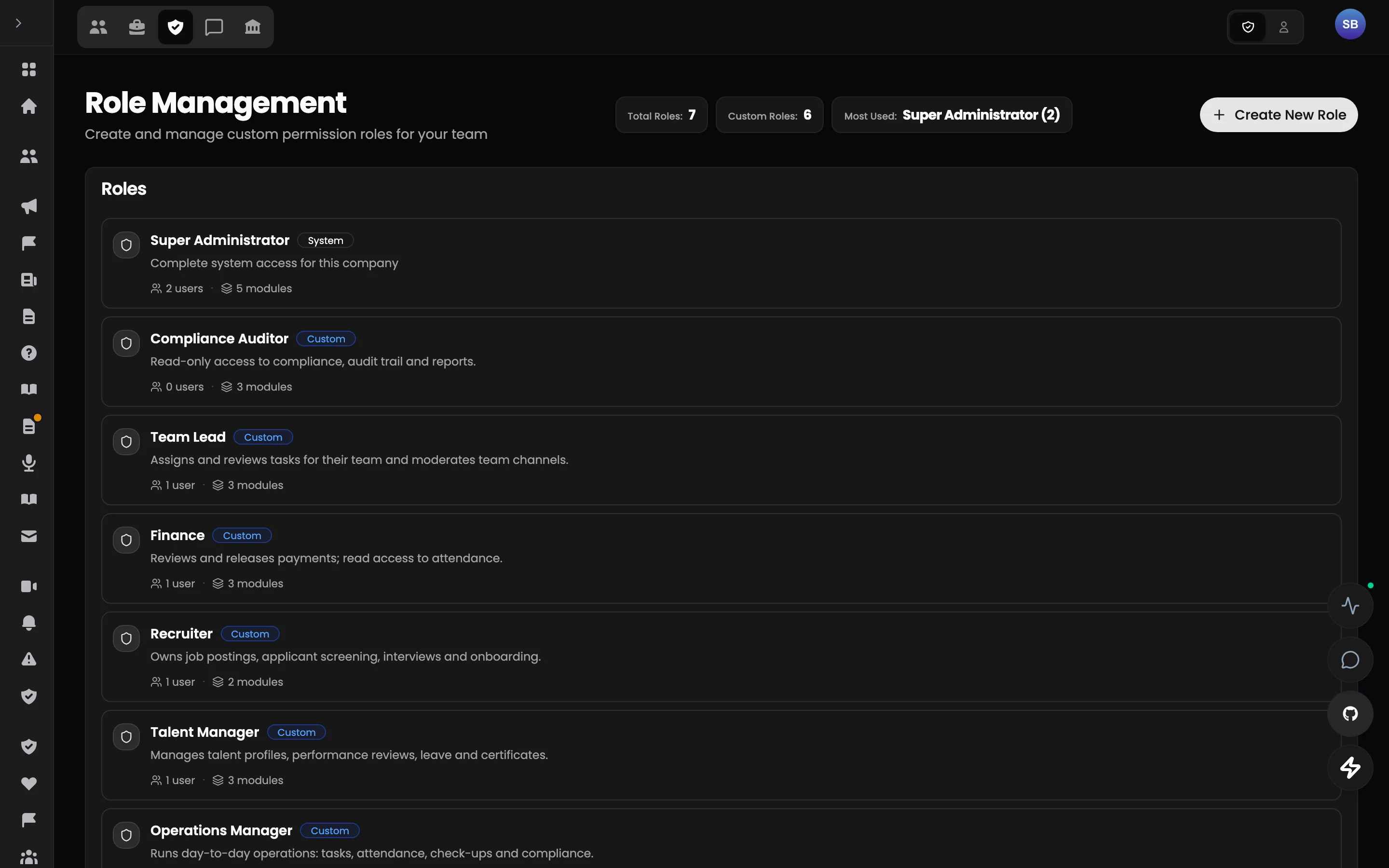
Operations
Admin
Govern the organization.
ExploreTrust
Governance built into every layer.
Granular roles, an audit trail of admin actions, portal access locks, masked phone numbers and optional two-factor sign-in.
SecurityEverywhere
Web, desktop and mobile.
In the browser, as a desktop app for Windows, and on mobile — with real-time updates and notifications on the channel each person reads.
PlatformThe pilot
How a pilot runs
- 01
Pick one area
One team or workflow where the friction is real.
- 02
We configure it
Workspace, roles, workflow and initial data — with your team.
- 03
Run it for real
The pilot team works in Kadrana, beside existing tools where needed.
- 04
Decide on evidence
What improved, what needs adapting, and whether to expand.
Questions
Asked before every pilot.
What is Kadrana?
A multi-tenant workforce operating system: hiring, tasks, shifts, check-ups, reports, pay, documents, learning and communication on one record — with a portal for admins and one for talents.
Who is it for?
Organizations that run work through a changing roster of people — agencies, operations teams, distributed teams and growing companies whose tools have multiplied one at a time.
Do we have to replace our existing tools?
No. A pilot starts with one area and runs alongside the current stack. Time tracking can stay connected (attendance is synchronised from Jibble), and other teams stay where they are.
Can it be adapted to how we work?
Yes. Roles, permissions, sidebar tabs, review rules, the check-in interval, XP, gates and evaluation weights are configured per organization — not coded. The check-up and report forms themselves are the same for every organization.
How is access controlled?
Roles are a matrix of module, feature and action. A talent's portal can be locked by hand or automatically after a set number of days without clocking in, phone numbers are masked for roles without the permission, and admin actions — changes to roles, permissions and admins among them — are written to an audit trail.
What does this mean for monitoring and a works council?
Kadrana records tasks, check-ups and attendance, so introducing it is a matter for your works council where you have one. What is recorded is configured, not fixed: the check-in interval is set per organization and per person (1 to 12 hours), the leaderboard can be hidden from the talent dashboard, talents can be limited to seeing only their own batch, and the weights behind the performance score are yours to set. Talents see their own score, check-ups and reviews.
Where is our data, and what about GDPR?
Every record carries its organization and every query is scoped to it at the data layer. Hosting region, a data processing agreement and retention periods are settled in the pilot conversation — we do not publish claims here that we cannot back up, so ask for them there, together with any security questionnaire.
What do we need for a pilot?
One internal owner who can make decisions about the workflow, the team or workflow you pick, input for the initial configuration — roles, steps, data — and feedback while it runs. We map the workflow with you, configure roles and permissions and support the pilot team's onboarding.
Where does AI come in?
In clearly bounded places: weekly summaries per person, résumé parsing, media transcription and explanations of performance figures, plus an assistant chat whose sessions admins can read in one monitor.
The pilot
Don't replace your stack on day one.
Start with the one workflow where fragmentation costs the most. Run Kadrana alongside your current tools, measure the result, and expand only if it works.